
Back to Interdependence (1)
Pushing in, tipping points and handing over

I have returned to the original Ableton Live set for Interdependence for the first time since presenting some of my practice research at the RMA Conference (Smith 2025). When I last worked on this system, I experimented with automation, using random LFOs to control certain effect parameters, and turn on and off the bit-crushing effect and Live’s Feedback Network device, which has become an integral part of the system. On reflection, there is something about this kind of indeterminacy that I do not particularly enjoy, as there is no perceivable link between my actions and the on/off state of these effects. In my system design, I want to be able to “imagine the program, not the results of the program” (Garnett 2001, 25). I believe this necessitates an understanding of how my actions cause certain types of behaviour within the system, but not an intimate knowledge of the sounds that they might produce (or in other words, the effects of my causes). Complete indeterminacy of the activation of effects does not allow me to imagine the interaction of behaviours.
The below extract of an improvisation with Interdependence shows the system in its previous state, with automation activating certain effects. Note a very short occurrence of the bit-crushing effect at 00:39, and shortly after this, the Feedback Network turning off until 01:37.
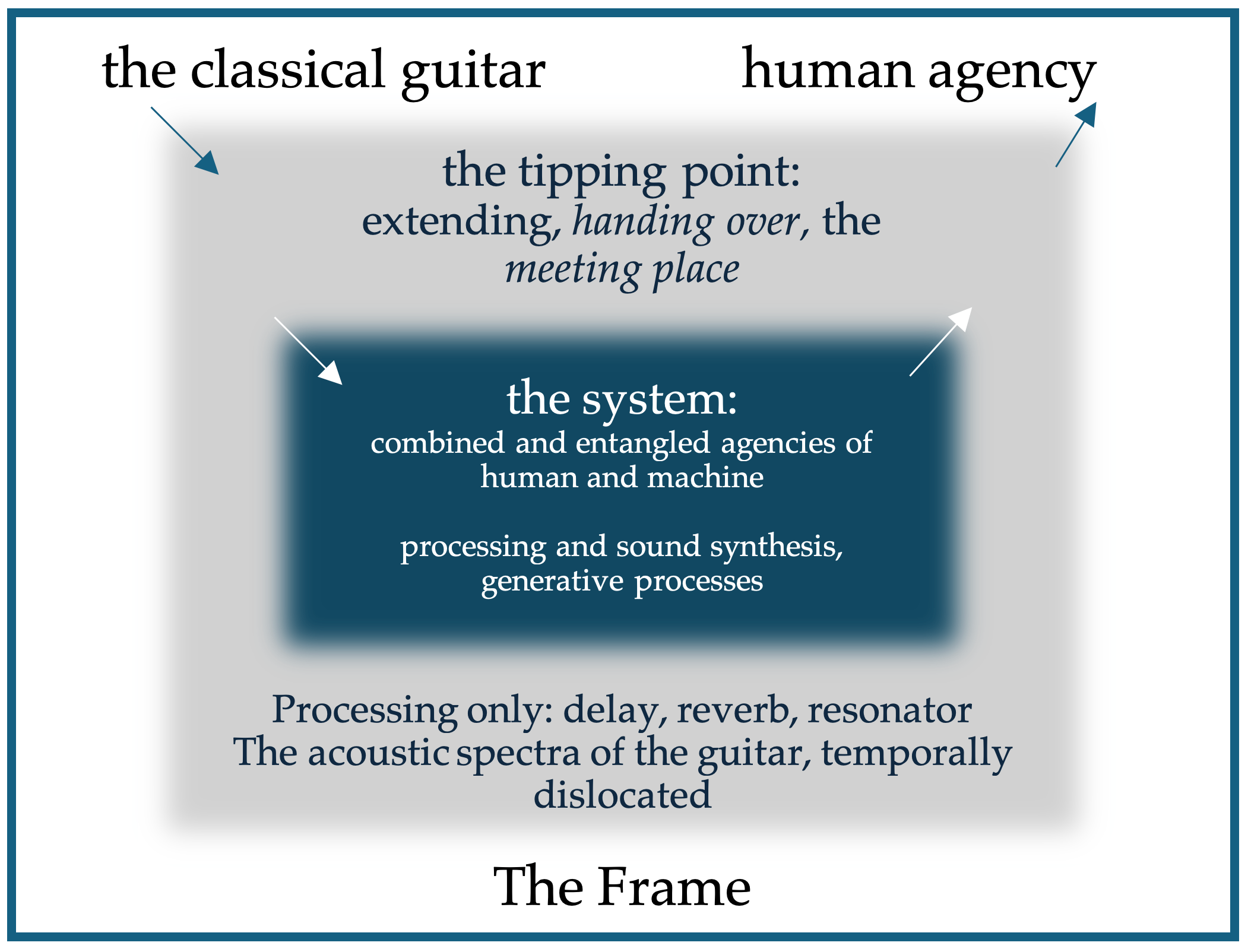
As well as (or maybe instead of) wayfaring, I am investigating the idea of using the guitar to push into the electronics. To do this, there must be a location to push from: one in which the guitar and electronics may coexist, but where my agency is directed only towards the guitar, and the guitar is the most prominent contributor to the overall sound produced.
I feel that this will be useful for my improvising too, as a reminder of the central role that I want the classical guitar to play in my work, and the transparency with which I want my systems to operate. I consider the classical guitar as the frame within which the system exists, and want to build into my systems a way to return to that frame during a performance. This way, the idea of an ‘extended’ or ‘augmented’ instrument becomes more demonstrable, as the handing over from human to machine is made audible.
Upon reopening Interdependence I’s Ableton Live set, I reconfigured some of the mappings, keeping the control of the drone generator the same, but removing the random LFOs which turn on the bit-crushing and Feedback Network. The feedback is now activated when the right pedal (two) reaches a certain threshold. A high pass filter is mapped to the left pedal (one), and decreasing this pedal allows me to sweep the filter cutoff from the top of the frequency range, effectively fading in the feedback.
The guitar signal is fed into a resonator (from the Confetti suite of devices for Max for Live (Constanzo, n.d.)) and the volume of this is controlled by an envelope follower mapped to the guitar signal, so that a higher playing dynamic on the guitar creates a ‘hyper-sustain’ of the instrument’s pitches. Effects like delays, reverbs and resonators provide an effective means of pushing into live electronics, as they temporally dislocate the recognisable acoustic sound (or, in the case of the resonator, its pitches), extending it from its moment of actuation. I find this location, where the agencies of human and machine meet and I hand over some agency to the system, to be the tipping point between the acoustic and electronic domains.
This positioning of a system as sitting somehow within the frame of the classical guitar, and the presence of a tipping point between the acoustic and the electronic domains, aligns my approach with the former of two paradigms for interaction with live electronics that Emmerson put forward in 2011. Here, the machine “seeks to extend the instrument out from its roots” while “remaining rooted in its source”, and “integrated with the original human performance action and perception” (Emmerson 2011, 168).
References
Constanzo, Rodrigo. n.d. Confetti. Accessed 29 September 2024. https://rodrigoconstanzo.com/confetti/.
Emmerson, Simon. 2011. ‘Combining the Acoustic and the Digital: Music for Instruments and Computers or Prerecorded Sound’. In The Oxford Handbook of Computer Music. Oxford University Press.
Garnett, Guy. 2001. ‘The Aesthetics of Interactive Computer Music’. Computer Music Journal 25 (1): 21–33.
Smith, Tom. 2025. ‘Interdependence: Meaningful Interactions, Wayfaring and System Virtuosity in Interactive Electroinstrumental Improvisation’. Royal Musical Association: 61st Annual Conference, University of Southampton, September 10.